We are happy to support Bill 26 (formerly known as Bill 177), The Domestic and Sexual Violence Workplace Leave and Training Accommodation Act.
Bill 26 recognizes the critical intersections between domestic violence and the workplace and introduces workplace provisions, including up to 10 days of paid leave for survivors to take paid time away from work to receive important support and services, such as legal support or counselling, without risk of losing their employment.
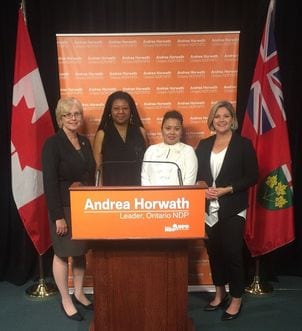
WomanACT joined a press conference on Thursday September 28th in support of Bill 157, an Act to increase workplace protection for survivors of domestic and sexual violence.
London West MPP Peggy Sattler’s Private Member’s Bill 26, Domestic and Sexual Violence Workplace Leave, Accommodation and Training Act, 2016 passed second reading in October 2016. On Thursday, NDP leader Andrea Horwath brought a new bill, Bill 157, Domestic and Sexual Violence Protection Act, 2017, for debate.
The new pill builds on the previous Private Member’s Bill and pushes for:
- Amending the Employment Standards Act (ESA) by requiring employers to provide leave to employees who have experienced DV or SV, or whose children have experienced DV or SV; This leave includes up to ten (10) days of paid leave, as well as 15 weeks of unpaid leave per calendar year.
- Including a provision that requires the paid portion of this leave to be covered by the Ontario government.
- Amending the Occupational Health and Safety Act (OHSA) to require that employers provide mandatory training on DV and SV to all managers, supervisors and workers.
The violence that women experience at home often extends into the workplace. A 2014 study by the Canadian Labour Congress and Western University’s Centre for Research & Education on Violence Against Women & Children found that of those workers who had experienced intimate partner violence, 82% reported that it had impacted their job performance and 10% reported that they were fired as a result of the impacts it had on their work. In addition, 42% of workers with experience of violence had disclosed it to someone at work. Access to income is a critical factor that can help women flee a violence relationship and maintain their safety and economic independence.
WomanACT supports Bill 157 because it recognizes the intersections between women’s safety and their employment and provides important resources and supports for survivors.
We are excited to announce a new project which will be undertaking intersectional gender-based analysis of public policies to better understand their impacts on survivors and advocate for policy change.
In October 2016, Status of Women Canada invited organizations to propose projects that advance gender equity across Canada. Through this call for proposals, the aim was to identify a total of 150 women leaders in various sectors, organizations, and communities across the country to mark the 150th anniversary of Confederation in 2017. On August 16, 2017, the Honourable Maryam Monsef, Minister for Status of Women Canada, announced funding to nine organizations across the Toronto region, including WomanACT, as part of this call for proposals. All projects will address systemic barriers over a 36-month period through three components: (1) increasing women’s economic security and propserity; (2) encouraging women and girls to be better represented in leadership and decision-making roles; and (3) ending violence against women and girls.
WomanACT’s 36-month project will prevent recurring violence against women by focusing on barriers that prevent women from accessing services, social benefits and safety measures when exiting emergency shelters. A gender analysis of the impact of policies related to social security, landed immigration status, child custody, affordable housing, and post-secondary education grants will be completed by working with stakeholders from community networks. This analysis will inform the development of an action plan to advance solutions to maximize safety and opportunities for women rebuilding violence free lives. The organization will host policy dialogues with municipal, provincial, and federal subject matter experts, strengthening longer term partnerships for systemic change. Recommendations and final project outcomes will be shared widely with partners, stakeholders and elected officials through ongoing dialogue.
Harmy Mendoza, Executive Director of WomanACT, shares that, “Leaving an abusive relationship can be a difficult and dangerous transition. This project will analyze the impact of policies in place to assist survivors of violence in rebuilding their lives. By working with our partners in the community and supporting policy dialogues, the project will strengthen longer term partnerships for systemic change. We will broadly share our knowledge and support the implementation of suggested recommendations.”