This brief present three key principles to guide the development of effective responses to technology-facilitated financial abuse in the context of Intimate Partner Violence (IPV). Identified through literature from Canada, the United States, Australia and the United Kingdom and grounded in consultations with survivors.
Service providers are incorporating these principles when designing solutions and practices to better support survivors, reduce harm, and prevent the misuse of financial technology. The brief outlines case studies of emerging, innovative practices that reflect these principles, aiming to enhance survivor safety, promote trauma-informed interventions, and raise awareness of this growing form of abuse.
The term innovative practices is used intentionally rather than “promising” or “best practices,” as these initiatives are still relatively new and require further evaluation to fully understand their effectiveness and long-term impact.
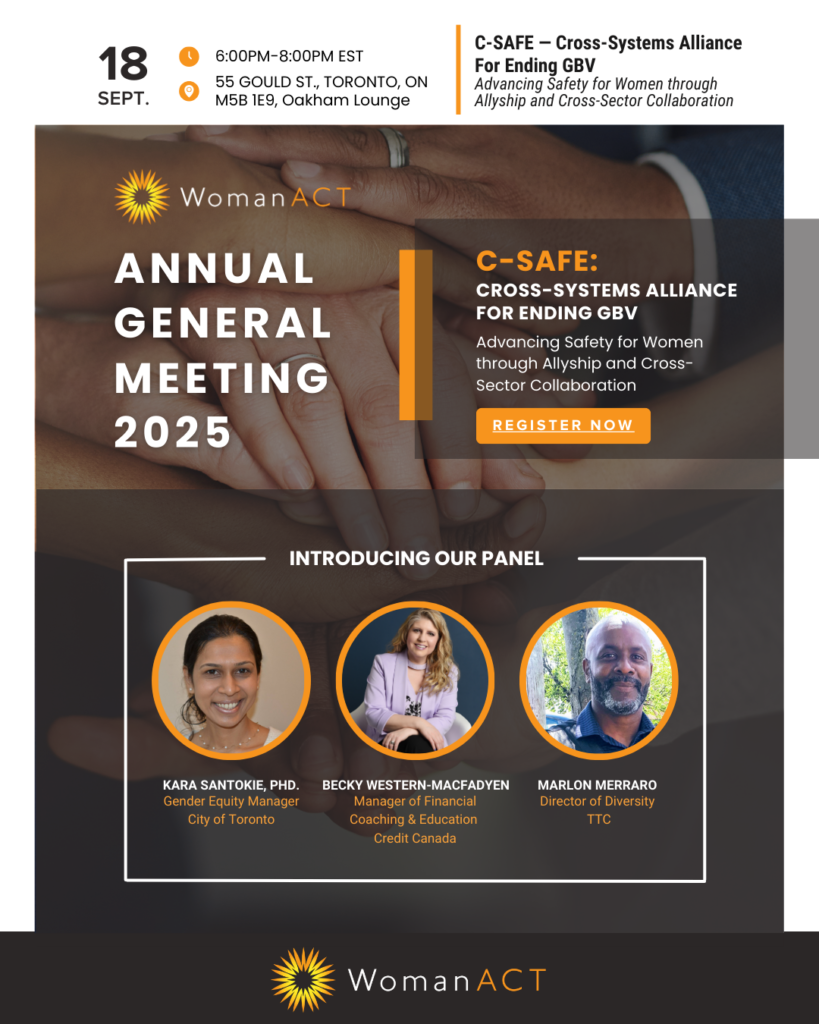
Join us at WomanACT’s Annual General Meeting! This year, our theme C-SAFE highlights the urgent need to address gender-based violence (GBV) not just within traditional sectors, but across all systems that shape safety, equity, and justice. The theme underscores that GBV is a cross-cutting issue—impacting workplaces, communities, education, healthcare, housing, technology, and beyond—and requires coordinated allyship and engagement at every level. This event will bring together experts to share their experiences, best practices, and insights on cross-sectoral collaboration.
COMING SOON: Panelist information
Refreshments and beverages will be served.
* Space is limited*
The Women’s Information for Safety and Empowerment in Trades project is designed to enhance workplace safety and gender equity for women entering skilled trades. The project aims to equip women entering employment in trades with information about their rights and resources for employees who experience sexual harassment while at work. It will also raise awareness to women’s experiences in trades and highlight practices that support safe and healthy work environments for women.

WomanACT’s feedback to the Toronto Police Service Board’s 2025–2028 Strategic Plan is the result of a collaborative process informed by the lived experiences and expertise of survivors, frontline organizations, researchers, and advocates across the violence against women (VAW) sector. Developed through consultations, both independently and as part of the City of Toronto’s IPV Working Group, this submission centers survivor voices and offers evidence-based, gender-responsive, and trauma-informed recommendations to address rising rates of intimate partner violence.
Drawing on over two decades of leadership in advancing gender equity, WomanACT’s submission highlights five key areas for reform: gender-responsive policing; integrated crisis response models with non-police alternatives; improved accountability and equity in data use; meaningful community partnerships rooted in survivor leadership; and strengthened internal practices to support diversity, wellness, and anti-oppression. This strategic planning process offers a critical opportunity to align the Board’s priorities with long-standing calls from the VAW sector, ensuring policing strategies are equitable, accountable, and responsive to the diverse needs of survivors, while focusing on prevention of intimate partner and gender-based violence.
This brief offers a summary of some of the key challenges East Asian women face in Canada, including racism, gendered violence, and economic exclusion. These challenges were specifically targeted at people associated with the diverse cultures of China, Japan, North Korea, South Korea, and Taiwan, which are often called East Asia.
While this brief focuses on ongoing barriers, it also honours the powerful ways East Asian women have resisted, redefined, and reclaimed their place in Canadian society.
We recognize that East Asian women in Canada are leaders, entrepreneurs, artists, and caregivers. Many are business owners and community advocates, creating support networks and spaces of care for others. They carry forward rich cultural traditions and strong family and community values, despite a long history of discrimination aimed at erasing or devaluing these contributions.
Violence against women (VAW) remains a predominant driver of women’s homelessness. Nevertheless, in many countries, including Canada, policy and programmatic responses to VAW and homelessness have developed in isolation from one another. This lack of integration significantly limits the effectiveness of efforts to address the complex and interconnected needs of women affected by both issues.
WomanACT collaborated on a research project with Dalhousie and the MAP Centre for Urban Health Solutions at St. Michael’s Hospital (Unity Health Toronto) that brought together academics and community advocates to examine the issue in a new research study published today in BMC Public Health. They analyzed existing interviews with 10 women accessing VAW services (MARCO-VAW Study) and 23 residents of encampments (MARCO-Encampments Study) at the height of the COVID-19 pandemic in Toronto.
Three themes were generated from the research analysis: exacerbation of inequities (abuse of) power and control as pathways into women’s homelessness; (2) negotiating trade-offs between safety and autonomy; and (3) gender stereotypes versus gender-transformative approaches. This infographic highlights some of the insights from the research paper.
To learn more about this research project, click here.
This Asian Heritage Month, we release our latest issue brief with heavy hearts, following the devastating tragedy that occurred on April 27, 2025, during the Lapu Lapu Festival Day in Vancouver, BC. What should have been a joyful celebration of Filipino heritage and resistance was tainted by a horrific attack that took the lives of 11 people and injured many more. We extend our deepest condolences to the victims, their families, and the entire Southeast Asian community affected that are grieving.
In the wake of this grief, we remain committed to honouring the lives, stories, and contributions of Southeast Asian women in Canada. Southeast Asia is a vast and diverse region encompassing Brunei, Cambodia, East Timor, Indonesia, Laos, Malaysia, Myanmar, the Philippines, Singapore, Thailand, and Vietnam. This brief is just a starting point in exploring the complex realities faced by women from these communities shaped by histories of colonization, displacement, and resilience.
Through this work, we uplift the voices and experiences of Southeast Asian women as leaders, artists, caregivers, and advocates, and we honour their enduring strength. In this issue, you’ll find Grace’s powerful story of migration and resistance, alongside many others who continue to shape and sustain vibrant communities in Canada.
On April 11th , WomanACT submitted a formal letter to Premier Doug Ford and all Members of Provincial Parliament, calling for the revival and passage of Bill 173 — The Intimate Partner Violence Epidemic Act.
Backed by over 30 community organizations, our letter urges the Ontario government to take action on the preventable and widespread crisis of intimate partner violence (IPV).
Recognizing IPV as an epidemic must go beyond symbolism—it requires lasting action, including new legislation, regulatory changes, policy directives, targeted programs, and sustainable budget measures. The Ontario government has an opportunity to take action, but only if we keep this issue at the forefront.

We all deserve a government that is committed to ending gender-based violence.
Canada will be having a federal election on April 28th, 2025. Every vote helps shape the policies that matter— gender equity and safety. Federal elections shape policies that impact gender equity and safety in our communities. Women, girls, and gender-diverse people across Canada—especially Indigenous, Black, trans, Two-Spirit, non-binary individuals, immigrant, refugee, and non-status women, and women with disabilities—are facing heightened risks of violence.
Every election matters, but now more than ever, Canada needs strong leadership and coordination across all levels of government to ensure sustained investments in gender-based violence prevention. 1 woman or girl is killed every 48 hours in Canada. Voting is a powerful way to hold candidates accountable and demand a future that prioritizes gender equity and safety for all.
Make gender equity a priority this election. Stay informed, ask questions, and vote for the future you want to see!
For more information voting visit: https://www.elections.ca/home.aspx
Calls to Action:
We urge all political parties to commit to ending gender-based violence through increased investment, coordinated strategy, and systemic change. Specifically, this election, we are calling for:
- A coordinated, funded, and community-led national strategy to end gender-based violence that prioritizes violence prevention.
- Strengthen systems collaboration focused on prevention, particularly for Indigenous and rural communities.
- Investment in affordable and safe housing options for women, gender-diverse people and their families, including the option to remain safely in their own homes.
- To declare Intimate Partner Violence (IPV) an epidemic.
- Allocate funding towards a comprehensive data collection and evaluation strategy to support evidence-based policies and programs for survivors.
Policy Recommendations
For policymakers and community members seeking to understand WomanACT’s policy positions and recommendations, please see our written submissions and statements below.
WomanACT Written Submission to the Toronto Police Service Board
How New Laws & Regulations are Created in The Province of Ontario
Issue Brief: Gender-Based Violence Service Provision and Access in Times of Crisis
Issue Brief: Information sharing and intimate partner violence in Canada
National Action Plan to End Gender-Based Violence: What we heard
Creating a Gender Equity Strategy and Gender Equality Office for Toronto
Ontario’s Social Assistance Programs: A Violence Against Women Perspective
Policy Impacts on Violence Against Women in Canada: A Review of Literature on Selected Policies
VAW Sector Representatives Recommendations: Income Security – A Roadmap for Change
Gender Housing Justice – Read Written Testimony
Support other community-based election campaigns
- #VotetoEngGBV campaign created by a dedicated coalition of anti-gender-based violence advocates and survivors who have united to urge all political candidates in the federal election to commit to ending GBV – www.votetoendgbv.com
- Social Planning Toronto – 2025 Federal Election Fact Sheets & Resources
- Action Ontarienne campaign resources – Élections Canada 2025
- Vote with Pride – Vote with Pride – Egale Canada
- VOTE – ApathyIsBoring
- Time to Vote – The Neighbourhood Group Community Services
- WomenVote – Ontario Federation of Labour
- Reclaiming Our Vote – Battered Women’s Support Services
- Demand Better
- The 519 Why We Vote – Why We Vote
Throughout Canadian history, Black women have faced slavery, discrimination in healthcare, segregation in education, and workplace inequities. Despite these challenges, Black communities have continuously resisted oppression, advocating for justice, dignity, and equality through collective action. However, systemic white supremacy persists, reinforcing structural violence and gendered racism against Black women and girls.
This publication builds on the notable sacrifices and tireless fight for equality led by researchers, activists, and community leaders who have long advocated for social justice and equity. Their collective and unwavering dedication continues to drive the dismantling of systemic barriers and actively challenge the bias and discrimination faced by Black women.