Part of the Navigating Trauma: Understanding the Counselling and Psychotherapy Experiences of Survivors of Intimate Partner Violence project, this study explores women survivors’ experiences accessing counselling and psychotherapy services. The research examines barriers to care, the impact of therapeutic relationships, and how counselling can support or hinder healing after intimate partner violence (IPV). Findings highlight the need for accessible, high-quality, trauma-informed mental health services that recognize survivors’ experiences and respond to their needs.
Priya Shastri and Premila Chellapermal of WomanACT served as project advisors, providing valuable guidance throughout the research process.
Citation:
Gutowski, E. R., Jahagirdar, A., Lisi, M., Retta, A., & Pichtikova, M. (2026). “By the Time You Get to That Trust Part, Your Sessions Are Done”: Women Intimate Partner Violence (IPV) Survivors’ Experiences with Counseling and Psychotherapy Services. 1–32. (2026) https://doi.org/10.1080/02703149.2026.2742297
WomanACT’s submission to the Government of Canada’s AI transparency consultation was informed by feedback from frontline GBV organizations, survivors, and sector professionals. The consultation explored how AI and technology-facilitated gender-based violence (TFGBV) are creating new risks for survivors, including deepfakes, image-based abuse, impersonation, stalking, surveillance, harassment, and coercive control, as well as less visible harms through automated or algorithmic decision-making.
The submission highlights the need for clear AI labelling and provenance requirements, stronger platform accountability and rapid-removal mechanisms, safety-by-design, improved tracking of AI-facilitated GBV, and meaningful involvement of survivors and the GBV sector in AI policy development. WomanACT calls for a gender-responsive, intersectional, and trauma-informed approach to AI transparency that recognizes AI-related harms cannot be left for survivors to identify and manage on their own.
Citation:
WomanACT. (2026). WomanACT’s Written Submission to Innovation, Science and Economic Development Canada: Enhancing Trust in Artificial Intelligence Through Increased Transparency.
Explore a collection of printable and shareable infographics designed to raise awareness about gendered microaggressions in engineering workplaces. These resources are great for training, presentations, awareness raising through social media, or community conversations—helping to identify, challenge, and respond to everyday behaviours that contribute to inequitable and exclusionary cultures in STEM.
This set of infographics was developed in collaboration with the Association of Consulting Engineering Companies (ACEC)— Ontario Women’s Community of Practice (CoP), bringing together sector expertise to support greater awareness and action on gendered microaggressions in engineering. We encourage you to use and share them widely to increase knowledge, spark dialogue and support more inclusive environments.
Citation:
| WomanACT. (2026). Infographics: Gendered Microaggressions in Engineering. https://womanact.ca/publications/gendered-microaggressions-in-engineering/ |
Campaign Partner/ Partenaire de campagne

Version en français disponible au bas de la page – French version available at the bottom of the page.
Advancing Inclusive Engineering Workplaces Together
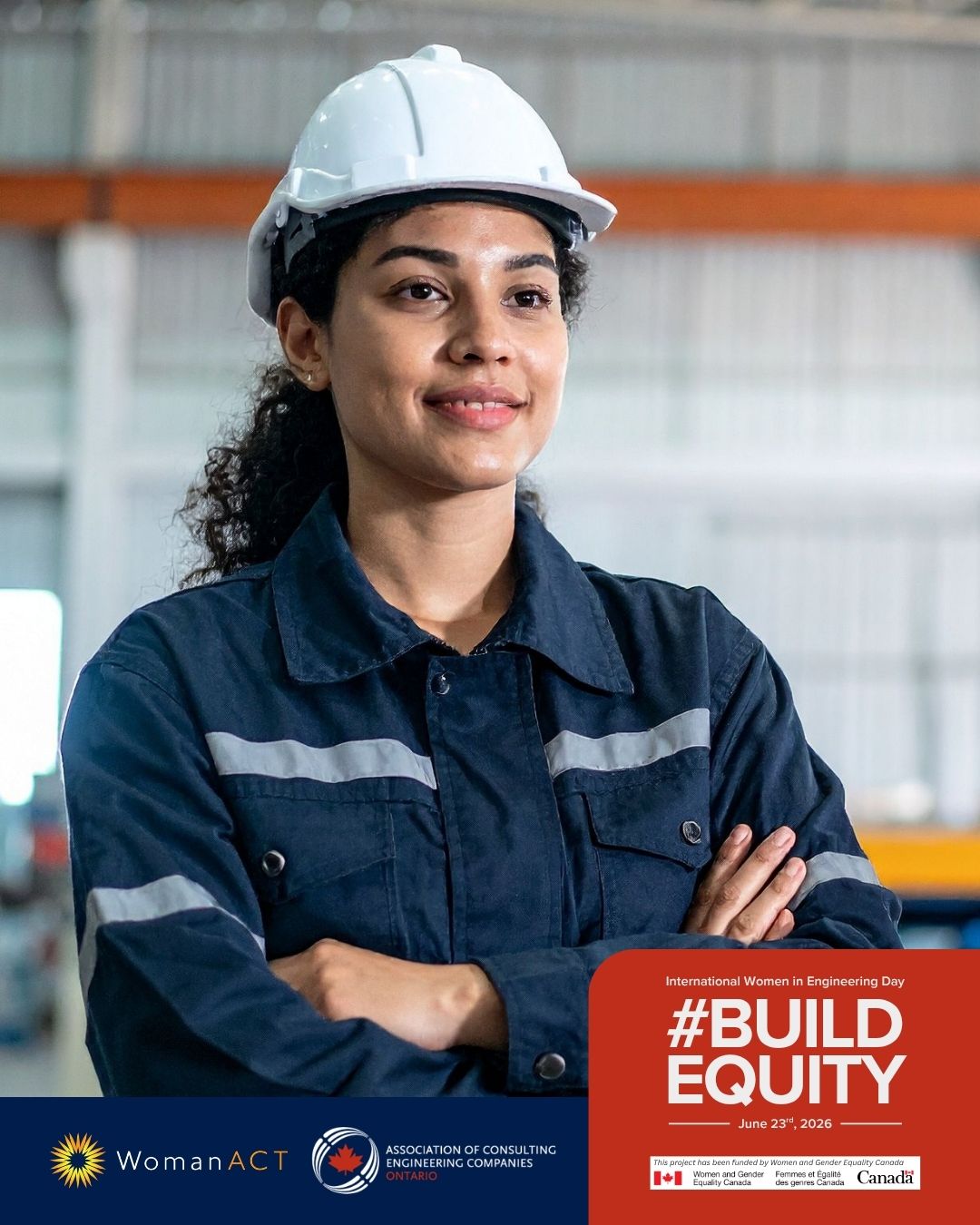
Between May 26th to June 26th, leading up to International Women in Engineering Day on June 23rd, WomanACT and ACEC-Ontario invite you to be part of #BUILDEquity—a campaign seeking to raise awareness to gendered microaggressions to foster more inclusive, respectful, and equitable engineering workplaces.
The campaign aligns with International Women in Engineering Day, a time to celebrate the achievements, leadership, and contributions of women across the engineering sector. It is also an opportunity to reflect on how we can continue to strengthen the culture of our workplaces ensuring that all professionals are supported, valued, and able to thrive.
About #BUILDEquity
#BUILDEquity reflects the collaboration behind this campaign, drawing from the Belonging, Understanding, Inclusion, Leadership, and Diversity in Engineering (BUILD-CoP), whose partnership with WomanACT co-produced the Gendered Microaggressions in Engineering infographics. Everyday interactions shape workplace culture and can have a significant impact on inclusion, belonging, and career progression in engineering. The campaign raises awareness of how gendered microaggressions show up in professional engineering workplaces, supports individuals and organizations with practical tools to recognize and address them, and encourages shared responsibility in building more equitable workplaces.
Get Involved
Building equity is a collective effort—and there are many ways to participate:
Download the infographics
Download and display the infographics (available in English & French ) in your workplace and use them as a catalyst for dialogue with colleagues.
Share and amplify
Use the instructions in the campaign toolkit containing ready-made social media assets and captions to post on your own channels. Remember to tag @WomanACT and ACEC Ontario and use #BUILDEquity to join the conversation.
Show your support
Engage with campaign posts by liking, sharing, and commenting to help expand reach and awareness.
Be an ally
Take time to reflect on your role in shaping workplace culture. Small, everyday actions can contribute to meaningful, lasting change.
Together, We BUILD Equity
Creating inclusive engineering workplaces doesn’t happen by chance—it happens through intention, awareness, and action.
Join us in recognizing the contributions of women in engineering while committing to the ongoing work of building environments where everyone can succeed.
Let’s BUILD Equity together!
This project has been funded through Women and Gender Equality Canada’s Women’s Program

Campagne #BUILDEquity
Faire progresser ensemble des milieux de travail inclusifs en ingénierie
Du 26 mai au 23 juin, en prévision de la Journée internationale des femmes en ingénierie, WomanACT et ACEC-Ontario vous invitent à participer à #BUILDEquity, une campagne visant à sensibiliser aux microagressions sexistes, afin de favoriser des milieux de travail en ingénierie plus inclusifs, plus respectueux et plus équitables.
Cette campagne s’inscrit dans le cadre de la Journée internationale des femmes en ingénierie, une occasion de célébrer les réalisations, le leadership et les contributions des femmes dans le secteur de l’ingénierie. C’est aussi l’occasion de réfléchir à la manière dont nous pouvons continuer à renforcer la culture de nos milieux de travail, afin de garantir que tous et toutes les professionnels soient soutenus, valorisés et puissent s’épanouir.
À propos de #BUILDEquity
#BUILDEquity reflète la collaboration à l’origine de cette campagne, s’appuyant sur la communauté de pratique BUILD-CoP (Belonging, Understanding, Inclusion, Leadership, and Diversity in Engineering), dont le partenariat avec WomanACT a permis de coproduire des infographies sur les microagressions fondées sur le en ingénierie. Les interactions quotidiennes façonnent la culture du lieu de travail et peuvent avoir des conséquences importantes sur l’inclusion, le sentiment d’appartenance et l’évolution de carrière en ingénierie. La campagne sensibilise à la manière dont les microagressions fondées sur le genre apparaissent dans les milieux de travail en ingénierie, soutient les personnes et les organisations avec des outils pratiques pour les reconnaître et les traiter, et encourage le partage des responsabilités dans l’établissement de milieux de travail plus équitables.
Impliquez-vous
Construire l’équité est un effort collectif, et il existe de nombreuses façons d’y participer :
Téléchargez les infographies
Téléchargez et affichez les infographies sur votre lieu de travail et utilisez-les comme point de départ pour dialoguer avec vos collègues.
Partagez et amplifiez
Utilisez la boîte à outils de la campagne contenant des ressources et des légendes prêtes à l’emploi pour les médias sociaux à publier sur vos propres chaînes. N’oubliez pas de mentionner @WomanACT et ACEC Ontario et d’utiliser #BUILDEquity pour vous joindre à la conversation.
Montrez votre soutien
Engagez-vous dans les publications de campagne en appréciant, en partageant et en commentant pour contribuer à accroître sa portée et sa notoriété.
Soyez un(e) allié(e)
Prenez le temps de réfléchir à votre rôle dans l’élaboration de la culture en milieu de travail. De petits gestes quotidiens peuvent contribuer à des changements importants et durables.
Ensemble, nous CONSTRUISONS l’équité
La création de lieux de travail inclusifs en ingénierie ne se fait pas par hasard, cela passe par la volonté, la sensibilisation et l’action.
Joignez-vous à nous pour reconnaître la contribution des femmes en ingénierie et pour poursuivre notre engagement en faveur de la construction d’environnements durables où tout le monde peut réussir.
CONSTRUISONS l’équité ensemble!
Ce projet a été financé par l’entremise du Programme de promotion de la femme de Femmes et Égalité des genres Canada

Advancing Equality: Addressing Workplace Harassment through Policy Change in the STEM Sector is an initiative aimed at raising awareness and driving collective action to tackle systemic challenges faced by women in STEM across Ontario. Women in STEM face persistent barriers, including gender bias, discrimination, and sexual harassment, which hinder their success and career progression. This project emphasizes cross-sector collaboration, bringing together industry leaders, survivor advocates, and gender equity experts to conduct research and co-develop impactful, evidence-based solutions. By fostering partnerships across diverse systems, the initiative seeks to create safer, more inclusive workplaces for women.
This project has been funded through Women and Gender Equality Canada’s Women’s Program
This brief present three key principles to guide the development of effective responses to technology-facilitated financial abuse in the context of Intimate Partner Violence (IPV). Identified through literature from Canada, the United States, Australia and the United Kingdom and grounded in consultations with survivors.
Service providers are incorporating these principles when designing solutions and practices to better support survivors, reduce harm, and prevent the misuse of financial technology. The brief outlines case studies of emerging, innovative practices that reflect these principles, aiming to enhance survivor safety, promote trauma-informed interventions, and raise awareness of this growing form of abuse.
The term innovative practices is used intentionally rather than “promising” or “best practices,” as these initiatives are still relatively new and require further evaluation to fully understand their effectiveness and long-term impact.
WomanACT. (2025). Innovative Practices for Identifying and Responding to Tech-Facilitated Financial Abuse. https://womanact.ca/publications/innovative-practices-for-identifying-and-responding-to-tech-facilitated-financial-abuse/
The Women’s Information for Safety and Empowerment in Trades project is designed to enhance workplace safety and gender equity for women entering skilled trades. The project aims to equip women entering employment in trades with information about their rights and resources for employees who experience sexual harassment while at work. It will also raise awareness to women’s experiences in trades and highlight practices that support safe and healthy work environments for women.

This brief offers a summary of some of the key challenges East Asian women face in Canada, including racism, gendered violence, and economic exclusion. These challenges were specifically targeted at people associated with the diverse cultures of China, Japan, North Korea, South Korea, and Taiwan, which are often called East Asia.
While this brief focuses on ongoing barriers, it also honours the powerful ways East Asian women have resisted, redefined, and reclaimed their place in Canadian society.
We recognize that East Asian women in Canada are leaders, entrepreneurs, artists, and caregivers. Many are business owners and community advocates, creating support networks and spaces of care for others. They carry forward rich cultural traditions and strong family and community values, despite a long history of discrimination aimed at erasing or devaluing these contributions.
Citation:
| WomanACT. (2025). East Asian Women in Canada. https://womanact.ca/publications/east-asian-women-in-canada/ |
The rise of the #MeToo movement has shifted dramatically society’s awareness of gender and sexual harassment, but global rates of gender and sexual harassment remain high. While there are many contributing factors, time and time again male-dominated workplaces are found to have higher rates of workplace gender and sexual harassment than spaces that have greater gender parity. This is particularly important for STEM fields, where women are a low percentage of the workforce.
This literature review explores the knowledge available on the subject of preventing and responding to gender and sexual harassment in the workplace, with a focus on STEM workplaces. It explores strategies for workplace prevention, training and response systems in addition to examples of best practices.
Citation:
| WomanACT. (2022). Literature Review: Safe STEM Workplaces. https://womanact.ca/publications/literature-review-safe-stem-workplaces/ |