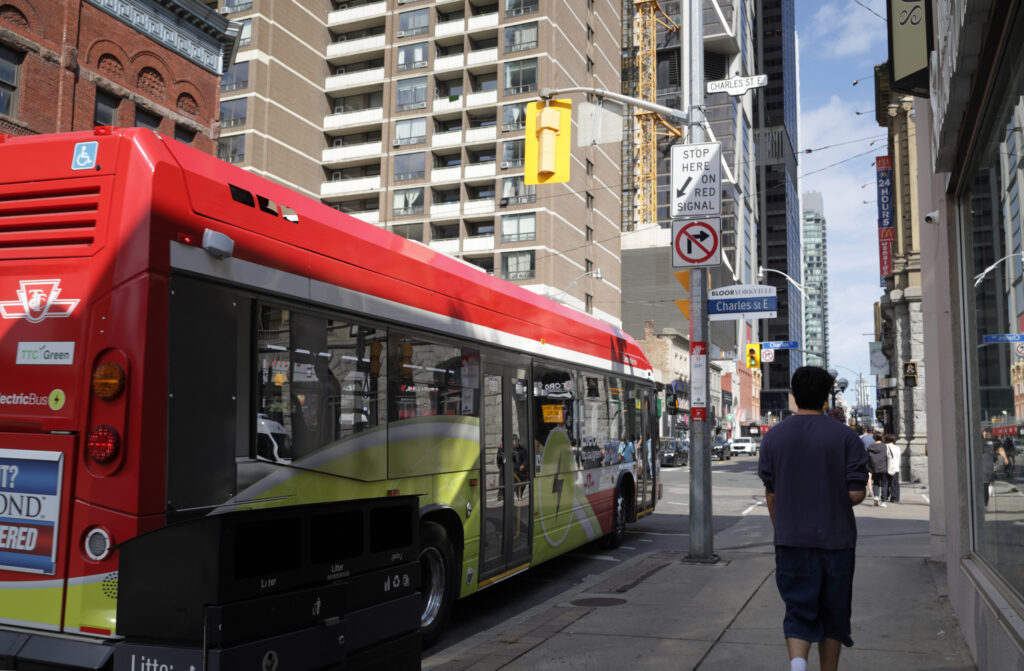
WomanACT is deeply concerned by the recent series of assaults on TTC buses in Scarborough and the impact these incidents have on riders’ sense of safety when using public transit.
According to the Toronto Police Service, two incidents occurred over September 23rd and 24th, 2026. On September 23rd, police allege that a man assaulted four passengers on a TTC bus travelling on Midland Avenue between Silver Star Boulevard and Huntingwood Drive. The following day, police allege that the same man assaulted another passenger on a TTC bus travelling southbound on McCowan Road near Alton Towers Circle. Police report that all five victims sustained non-life-threatening injuries and were not known to the accused. A 37-year-old man was arrested and charged with five counts of assault.
Concerns have been raised about whether some of the victims may have been targeted because of their gender, race, or faith. Media reports indicate that three of the four victims in the September 23rd incident were women and South Asian. Police have stated that the incidents are not currently being investigated as hate-motivated, although the Toronto Police Service Hate Crime Unit has been notified.
Regardless of motive, no one should have to fear being assaulted while commuting to work, travelling home, or simply moving through their city. The impact of violence on transit extends beyond the immediate physical harm. Experiences of harassment and violence can fundamentally change how people navigate public space, where and when they travel, and whether they feel able to use public transit at all.
This is not an isolated concern. WomanACT’s research has found that harassment on public transit is widespread and that women experience forms of sexual and gender-based harassment at significantly higher rates than men. In a survey of 1,550 Toronto residents conducted in partnership with Angus Reid Group, 86% of transit riders reported experiencing some form of harassment. Women were more likely than men to report unwanted sexual looks or gestures (59% compared with 22%) and sexual comments (50% compared with 19%).
Our research also found significant differences in perceptions of safety. Thirty per cent of women reported feeling unsafe on public transit, compared with 23% of men. Racialized women were also more likely than white women to report feeling unsafe. Feelings of safety were particularly affected by travelling at night: 39% of women reported feeling safe or very safe travelling at night, compared with 57% of men.
These experiences have real consequences. Women told us they adapt their behaviours to manage the risk of harassment and violence: staying on high alert, using their phones to avoid unwanted attention, avoiding transit after dark, getting off at earlier stops, travelling with others, and, for some, choosing not to make a trip at all.
Safety should not be a barrier to accessing public transit, employment, education, services, or community life.
WomanACT has consistently advocated for a systems-level approach to preventing and responding to gender-based violence on public transit. This means recognizing that transit safety is not only about responding after an assault occurs. It requires investment in infrastructure, prevention, staff training, community engagement, and meaningful accountability.
WomanACT’s call to action:
- Equip Riders and Strengthen Accountability: Riders should have access to clear, accessible information about how to recognize harassment, safely intervene, support someone experiencing violence, and report incidents. Reports should receive timely, survivor-centered follow up, so riders know what happens after they come forward. The TTC should regularly publish data on harassment and violence on the system, broken down by gender, race and other identities where it is safe to do so, along with the actions taken in response. This would allow the public, communities and decision-makers to see where riders are most at risk and whether safety measures are working.
- Invest in safer transit infrastructure and environments: Improve lighting at stops, stations, and walking routes; maintain clean and visible transit spaces; expand emergency call systems, real-time arrival information, and reliable security cameras; and ensure safety features are accessible and functional.
- Strengthen prevention and training for transit employees.
Transit employees should receive ongoing, trauma-informed training on gender-based violence, sexual harassment, bystander intervention, de-escalation, and how to respond when someone experiences or discloses violence or harassment. Our research found that while 95% of respondents considered information on how to intervene important, only 56% said they would know how to intervene if they saw someone in danger on public transit.
- Meaningfully involve women and gender-based violence organizations in transit safety planning: Establish ongoing, meaningful participation of women’s and gender-based violence organizations in TTC safety planning, implementation, and evaluation, with particular attention to the experiences of racialized women and other riders facing heightened barriers to safety. In our research, 87% of respondents agreed that women’s organizations should be consulted about public transit safety.
Women should not have to change how, when, or whether they travel because they are trying to avoid harassment or violence. Safety is not an individual responsibility; it is a systems responsibility. With Ontario’s municipal elections taking place on October 26th, 2026, transit safety is an especially important issue for public discussion. Transit, public safety, and the accessibility of public spaces are all areas where municipal leadership, investment, planning, and accountability matter. The choices made by municipal governments shape the transit environments people rely on every day, . Iincluding how safety is funded, planned, implemented, and evaluated.
As candidates and communities discuss Toronto’s future, transit safety must be part of that conversation. We need more than responses after violence occurs. We need sustained investment in prevention, safer transit infrastructure, staff training, gender-responsive policies, meaningful community engagement, and mechanisms to understand whether safety measures are improving riders’ experiences.
WomanACT will continue to advocate for gender-responsive, survivor-centred, and evidence-informed approaches to transit safety, and for the meaningful involvement of women and gender-based violence organizations in shaping solutions. We encourage candidates, transit decision-makers, and the public to treat safety as a fundamental part of accessible public transit.
Everyone should be able to move through Toronto safely, with dignity and without having to change their lives to manage the risk of violence. Public transit should be accessible and safe for everyone.
Media Contact
Aakanksha Mathur (she/her)
Manager of Public Policy, Advocacy and Communications
WomanACT
416-944-9242 Ext. 231
amathur@womanact.ca
womanact.ca
Let's stay in touch
Get WomanACT news delivered to your inbox.